Azuay Forum Highlights Tourism as a Key Driver of Development
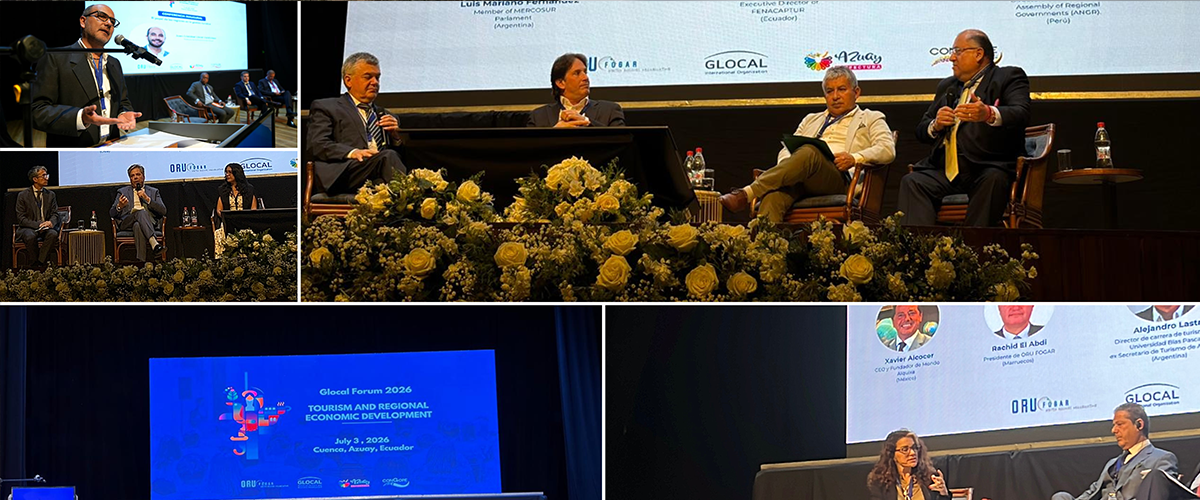
The Tourism and Regional Development Forum, organized by ORU Fogar on 3 July together with the Provincial Government of Azuay as host, GLOCAL, which provided the technical expertise, and with the support of CONGOPE, left no doubt that tourism can be a key driver of development.
The 45 speakers who took part in the Forum agreed that every territory has something to showcase. Some possess natural heritage, others cultural heritage, while others have a unique gastronomy to offer. It also became clear that religious tourism flows can be harnessed. As one speaker vividly put it, “a glacier can be just as valuable a tourism asset as a desert.”
During the opening session, Maximiliano Mauvecín, Director of GLOCAL, expanded on this argument by explaining that tourism is the economic sector most closely linked to territory. “An industry,” he said, “can relocate elsewhere if it is offered better economic conditions, lower labour costs or a more highly qualified workforce. Landscapes, cultural heritage and even hotels, however, cannot be relocated.” He therefore called on regional governments to devote greater attention to the tourism sector.
During the same opening session, Richard Campbell, Director of Culture and Tourism at the Organization of American States (OAS), and Heitor Kadri, Director of the UN Tourism Regional Office for the Americas, encouraged regions to take on a leadership role. Campbell highlighted the decisive contribution that regions make to the development of the tourism sector. This view was reinforced by Heitor Kadri, who stressed that, in light of the mobility of millions of people around the world, smart and coordinated regional governance is imperative.
However, it was Rachid El Abdi, President of ORU Fogar, who argued that the regional level is the strategic scale for maximizing tourism's potential and turning it into a genuine tool for economic and social transformation. He explained that regions play a key role in bringing together the various stakeholders involved. For the President of ORU Fogar, regions are the essential link. “Regions act as a natural bridge between the local and national levels. Moreover, they provide the ideal space for fostering strong public-private partnerships, while also bringing together academia and civil society within a strategic planning framework that delivers lasting results,” he said.
The Prefect of Azuay, Juan Cristóbal Lloret, reinforced this view by explaining that the regional level can be decisive in ensuring that the benefits of tourism reach parts of the territory where market forces alone would not. It also enables all sectors of society to participate in tourism development. According to Lloret, “regions have the capacity to steer tourism flows through targeted strategies towards historically excluded areas, ensuring that the economic benefits reach social groups that would otherwise be unable to benefit from this resource.”
Building on these premises, the Forum became an important platform for reflection on the role of tourism in territorial planning, highlighting that, far from being an isolated activity, tourism is a cross-cutting driver of economic development, sustainability and social cohesion. The Forum also served as a platform for the exchange of experiences. Representatives from regions in Spain, Morocco, Côte d'Ivoire, Argentina, Peru, Chile, Brazil and Mexico shared their tourism best practices, discussing how regional planning can transform territorial identity into an asset for sustainable development.
Examples were presented of how heritage has been transformed into a tourism asset in Côte d'Ivoire, the Peruvian Andes and Ecuador. Another session explored the potential of MICE tourism (Meetings, Incentives, Conferences and Exhibitions), showcasing initiatives developed in territories as diverse as the Province of Córdoba and the Regional Council of Rabat-Salé-Kénitra. During another panel discussion, speakers from Ecuador, Spain, Argentina and Brazil shared their experiences in applying Artificial Intelligence to the tourism sector. The session entitled “Tourism, Gastronomy and Food Sovereignty” demonstrated how the Basque Country, as well as Azuay and Manabí in Ecuador, have successfully transformed their gastronomy into a leading tourism asset.
The Forum also featured sessions in which governors and regional presidents from diverse territories shared their experiences of public-private cooperation in the tourism sector, while others presented tourism projects aimed at engaging younger segments of the population. Another session addressed the debate on how to finance tourism infrastructure, during which the possibility of introducing regional tourism taxes was also discussed.
Beyond the institutional representatives, the Forum brought together renowned experts such as Jaime Guazzini, President of FEDESUD (South American Tourism Federation); Alain Jordá, a Catalan specialist in tourism and territorial economic development; and Mauricio Ferro Rettig, Director of Smart Planet. The contributions made by Ecuadorian civil society and the business community –particularly those from Azuay– were also especially noteworthy.
Several speakers pointed out that uncontrolled tourism flows, rather than serving as a driver of development, could have detrimental effects on host communities. Examples were presented of how tourism pressure can disrupt local housing markets. It was also highlighted that, alongside a form of tourism capable of strengthening local identity, there can be another that erodes it, diluting local culture and degrading natural, cultural and historical heritage. Many speakers stressed the importance of respecting carrying capacity, and nearly all emphasized the need for tourism to be sustainable. Some even argued that it should be regenerative.
During the closing session, Carles Llorens, Secretary General of ORU Fogar, stated that the Forum had reaffirmed the partnership with the Provincial Government of Azuay, a relationship dating back to the founding of the organization in 2008, thereby consolidating the province as a leading reference for regionalism in Latin America. He added that the Forum had also opened a new avenue of cooperation with GLOCAL, enabling regions around the world to continue placing tourism high on their agendas. He concluded by thanking Prefect Juan Cristóbal Lloret, Maximiliano Mauvecín, and their respective teams for their joint efforts.
In conclusion, the Forum, which closed with the reading of the Azuay Manifesto, adopted by the ORU Fogar Annual Assembly, reaffirmed the commitment of ORU Fogar and its partners to continue promoting governance models in which regions play a leading role in shaping the economic and social future of their communities.
Azuay Manifesto