Migration Is Territorial: Why Regions Matter More Than Ever
Elena (Olena) Tsvirko
Doctor of Economic Sciences, Professor
Professor visiting Postgraduate Program in Regional Development and Agribusiness (PGDRA) at Western Paraná State University – UNIOESTE (Toledo, PR, Brazil)
Professor – State University of Infrastructure and Technologies (Ukraine)
Migration has become one of the defining territorial challenges of the twenty-first century.
Some regions are losing population. Others are receiving migrants. Still others serve as transit territories. Increasingly, many regions perform all three roles at the same time. For this reason, successful migration governance no longer depends exclusively on national governments. It increasingly depends on regions.
Today, more people than ever before live outside the country where they were born. Europe and Asia host almost two-thirds of the world's international migrants, followed by North America, Africa, Latin America and the Caribbean, and Oceania. The United States remains the world's largest destination country, hosting more than 50 million international migrants. People continue to move in search of security, employment, education and better opportunities for themselves and their families.
According to the World Migration Report 2026, the number of international migrants reached 304 million in 2024, compared with 72 million in 1960. Yet migrants still represent only 3.7% of the world's population, demonstrating that migration is no longer an exceptional phenomenon but a permanent feature of global development. These movements are driven by long-term economic, demographic, social and political forces that transform some territories into magnets for human capital while leaving others confronted with depopulation, ageing populations and labour shortages.
Figure 1. Growth of the International Migrant Population and Its Share of the World's Population, 1960-2024
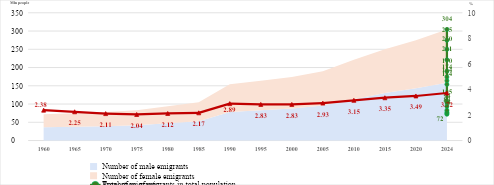
Source: Migration Data Portal (2025); UN DESA (2025).
Migration should therefore be understood not simply as a phenomenon to be managed, but as a territorial process capable of reshaping regional economies, societies and demographic structures. This requires more than national migration policies. It calls for strong regional leadership, long-term planning and sustained investment in human capital.
People migrate for many different reasons. Some flee armed conflict, persecution, political instability or climate-related disasters. Others move voluntarily in search of employment, education, family reunification or better living conditions. While the drivers of migration differ considerably, their territorial consequences are remarkably similar. Regions must respond to demographic change, labour market shortages, growing demand for housing and public services, and the challenge of integrating newcomers into local communities.
Migration has become an important driver of regional development. It helps address labour shortages, stimulates entrepreneurship and innovation, strengthens trade and investment, and facilitates the exchange of knowledge and skills. Remittances sent by migrants support millions of households and contribute significantly to local development in countries of origin. At the same time, migration also creates important challenges, including pressure on infrastructure and public services, social cohesion, integration and the loss of skilled workers from less developed regions.
For this reason, migration can no longer be viewed solely through the lens of border management. Its long-term success depends on what happens after people arrive - whether they find employment, gain access to education, become part of local communities and contribute to regional development. This is where regions become indispensable.
Regional governments are uniquely positioned to connect migration policy with territorial development. They understand local labour market needs, demographic trends and economic priorities better than national institutions. They work directly with municipalities, employers, universities, civil society organisations and local communities, allowing them to respond quickly and effectively to migration-related challenges.
Regions can attract the skills their economies need, facilitate the recognition of foreign qualifications, invest in language training and professional integration, strengthen cooperation between educational institutions and employers, and create inclusive communities where newcomers become active contributors to local development. In doing so, they can transform migration from a demographic challenge into a driver of innovation, competitiveness and sustainable territorial development.
International cooperation further strengthens these efforts. Through networks such as ORU Fogar, regional governments can exchange successful practices, develop joint initiatives and learn from territories facing similar migration challenges despite their different geographical, economic and cultural contexts. Cooperation among regions creates opportunities for more balanced, evidence-based and people-centred migration governance.
The future of migration policy will not be shaped only in national capitals. It will be shaped in regions - where people live, work, study, establish businesses, raise families and build their futures. It is here that decisions affecting integration, human capital, social cohesion and territorial resilience are made every day.
It is time to recognise that regions are no longer simply implementing national migration policies. They are becoming strategic actors in designing them. Strong regions can transform migration from a source of pressure into an opportunity for economic growth, social resilience and international cooperation.
Migration should be governed not only at national borders, but above all where the future of people and territories is built - in the regions.